Sand Calculator
Calculate sand volume, weight, and cost estimates for construction, landscaping, and DIY projects. Professional-grade calculations with multiple measurement units.
🏗️ Perfect for: Construction fill, concrete mixing, landscaping, sandboxes, paver bedding, pool foundations, and more.
📏 Supports: Metric (meters, cubic meters, tonnes) and Imperial (feet, cubic yards, tons) units with automatic conversion.
💰 Includes: Cost estimation, delivery calculations, compaction factors, and waste allowance recommendations.
⚡ Quick Presets: Select a common project below to auto-fill typical dimensions
Select Project Type
Select Area Shape
Select Sand Type
Cost Estimation
Delivery Truck Information
Sand Calculation Results
Volume Breakdown
- Base Volume: 0 m³
- Waste Allowance (10%): 0 m³
- Compaction Adjustment: 0 m³
- Final Required Volume: 0 m³
Weight Equivalents
| Unit | Value | Notes |
|---|---|---|
| Kilograms (kg) | 0 | Metric weight |
| Tonnes (t) | 0 | 1,000 kg |
| Pounds (lb) | 0 | Imperial weight |
| US Tons | 0 | 2,000 lbs |
Step-by-Step Calculation
1Calculate Base Area: Length × Width = 0 m²
2Calculate Base Volume: Area × Depth = 0 m³
3Apply Compaction Factor: Volume × Compaction = 0 m³
4Add Waste Allowance: Compacted Volume × (1 + Waste%) = 0 m³
5Calculate Weight: Final Volume × Density = 0 kg
6Calculate Cost: Weight × Price + Delivery = $0
About Sand Types
General Purpose Sand: The most versatile option, suitable for filling, leveling, and general construction. Moderate grain size with good drainage properties.
Pro Tips
🎯 Order 10-15% extra to account for compaction and waste. It's better to have a small surplus than run short mid-project.
🚛 Delivery considerations: Ensure your site has adequate access for delivery trucks. Soft ground may require plywood sheets to prevent trucks from getting stuck.
🏗️ Moisture matters: Wet sand weighs significantly more than dry sand (up to 20% difference). Most density figures assume moderately moist sand.
📏 Depth guidelines: Paver bedding typically needs 1-2 inches (25-50mm). Concrete projects need precise sand-to-cement ratios.
⏰ Timing: Schedule deliveries when you're ready to use the sand. Prolonged storage can lead to contamination or moisture issues.
🌧️ Weather protection: Cover stored sand with tarps to prevent rain saturation and wind dispersal.
Sand Application Guide
🏗️ Construction Fill: Used for leveling ground, filling trenches, and creating stable bases. Requires good compaction for structural integrity.
🌿 Landscaping: Improves soil drainage and texture. Mix with topsoil for better plant growth. Ideal for creating level surfaces for lawns.
🏖️ Sandbox: Use only certified play sand that's washed, screened, and non-toxic. Replace every 2-3 years for hygiene.
🧱 Paver Bedding: Creates a stable, level base for pavers. Typically 1-2 inches deep. Use coarse sand for better drainage.
🪨 Concrete Mix: Standard ratio is 1 part cement : 2 parts sand : 3 parts gravel. Use clean, washed concrete sand.
🏊 Pool Base: Provides cushioning and leveling under pool liners. Use fine, washed sand to prevent punctures.
Common Mistakes to Avoid
❌ Underestimating compaction: Loose sand can compact by 10-20%. Always account for this in your calculations.
❌ Wrong sand type: Using play sand for construction or fill sand for sandboxes can cause problems. Match sand type to application.
❌ Ignoring drainage: Poor drainage can cause sand to wash away or become waterlogged. Ensure proper grading.
❌ Skipping base preparation: Always prepare the base properly. Remove vegetation, level the ground, and compact before adding sand.
❌ Mixing contaminated sand: Avoid sand with clay, silt, or organic matter for structural applications.
Sand Type Comparison Chart
| Sand Type | Grain Size | Best For | Compaction | Price Range |
|---|---|---|---|---|
| General Purpose | Medium | Fill, leveling, general use | Good | $-$$ |
| Masonry Sand | Fine | Mortar, brick laying | Moderate | $$ |
| Concrete Sand | Coarse | Concrete mixing, drainage | Excellent | $$ |
| Play Sand | Very Fine | Sandboxes, play areas | Poor | $$$ |
| Silica Sand | Uniform | Filtration, industrial | Good | $$$ |
| Fill Sand | Mixed | Structural fill, grading | Excellent | $ |
💰 Cost Saving Tips: Buy in bulk for large projects. Compare prices from multiple suppliers. Consider picking up yourself if you have a suitable vehicle. Off-season purchases may offer discounts.
Delivery Summary
⚠️ Important: Always verify truck capacity with your supplier. Weight limits may vary by region and vehicle type. Some suppliers charge per load rather than per tonne.
Frequently Asked Questions
Q: How much does a cubic meter of sand weigh?
A: It depends on the sand type and moisture content. Dry sand typically weighs 1,400-1,600 kg/m³ (87-100 lb/ft³), while wet sand can weigh up to 2,000 kg/m³ (125 lb/ft³). Our calculator uses industry-standard densities for each sand type.
Q: How do I convert cubic meters to cubic yards?
A: Multiply cubic meters by 1.30795 to get cubic yards. For example, 10 m³ = 13.08 yd³. Our calculator does this automatically when you switch to Imperial units.
Q: What's the difference between a tonne and a ton?
A: A metric tonne (t) = 1,000 kg = 2,204.62 lbs. A US ton = 2,000 lbs = 907.18 kg. A tonne is about 10% heavier than a US ton.
Q: How deep should sand be for pavers?
A: Typically 1-2 inches (25-50mm) of coarse sand is recommended for paver bedding. This provides adequate cushioning and leveling while allowing proper drainage.
Q: Can I use play sand for construction?
A: No. Play sand is too fine and doesn't compact well. Use general purpose or fill sand for construction projects. Play sand is specifically processed for safety in children's play areas.
Q: Why do I need to add waste allowance?
A: Sand can be lost during delivery, spreading, and compaction. Irregular surfaces may require more material than calculated. A 10-15% waste allowance ensures you have enough to complete your project.
Q: What is compaction factor?
A: Compaction factor accounts for volume reduction when sand is compressed. Loose sand occupies more space than compacted sand. For structural applications, always account for compaction (typically 5-20% volume reduction).
Q: How long can I store sand?
A: Properly stored sand (covered, dry location) can last indefinitely. However, outdoor storage should be limited to a few months to prevent contamination, weed growth, and moisture issues.
Q: What's the best sand for concrete?
A: Use clean, washed concrete sand with angular particles. The standard concrete mix ratio is 1:2:3 (cement:sand:gravel). Avoid sand with clay, silt, or organic matter.
Q: How many 25kg bags equal one tonne?
A: 40 bags of 25kg each equal 1,000 kg (1 tonne). However, buying bulk sand is usually more economical for large projects.
Q: Can I mix different types of sand?
A: Generally not recommended. Different sand types have different grain sizes and properties. Mixing can result in poor compaction, drainage issues, or structural problems.
Q: How do I calculate sand for irregular shapes?
A: Break the area into multiple regular shapes (rectangles, triangles, circles), calculate each separately, then add the results. For very complex shapes, consider using the average dimensions.
📞 Still have questions? Contact your local sand supplier for specific recommendations based on your project requirements and local conditions. They can provide valuable insights about regional sand characteristics and delivery options.
Environmental Considerations
♻️ Sustainable sourcing: Choose suppliers who practice responsible sand mining. Excessive sand extraction can harm ecosystems and waterways.
🌊 Beach sand alternatives: Never use beach sand for construction. It contains salt and shells that weaken concrete. Use manufactured or river sand instead.
🔄 Recycling options: Consider recycled concrete sand for non-structural applications. It's environmentally friendly and often more affordable.
💧 Water conservation: Washed sand requires significant water. Ask suppliers about their water recycling practices.
🚛 Carbon footprint: Local sourcing reduces transportation emissions. Calculate delivery distance when comparing suppliers.
Material Comparison: Sand vs Alternatives
| Material | Cost | Drainage | Compaction | Best Use |
|---|---|---|---|---|
| Sand | $$ | Excellent | Good | General purpose, leveling |
| Gravel | $$ | Excellent | Excellent | Drainage, driveways |
| Crushed Stone | $$$ | Good | Excellent | Base layers, roads |
| Topsoil | $$ | Moderate | Poor | Gardening, landscaping |
| Pea Gravel | $$$ | Excellent | Poor | Decorative, pathways |
| Decomposed Granite | $$ | Good | Good | Pathways, patios |
In construction, landscaping, and even small home improvement projects, estimating the correct amount of materials is one of the most important steps before starting the work. Among the most commonly used materials in building and ground preparation is sand. Whether you are installing paving stones, preparing a concrete mix, building a patio, leveling ground for landscaping, or creating a playground area, sand plays a crucial role in ensuring structural stability and durability. This is where a sand calculator becomes extremely useful.
A sand calculator is a digital or manual estimation tool designed to determine how much sand is needed for a specific project based on measurements such as length, width, and depth. Instead of relying on rough guesses or outdated estimation methods, this tool allows builders, contractors, landscapers, and DIY enthusiasts to calculate material quantities more accurately. Accurate calculation not only helps ensure the project runs smoothly but also prevents unnecessary costs caused by ordering too much or too little material.
In the past, builders often relied on experience and rough volume calculations to estimate sand requirements. While experienced professionals could make fairly accurate predictions, mistakes still occurred frequently, especially on large-scale projects. Miscalculations could lead to delays, increased transportation costs, or additional purchases that disrupt project schedules. Today, the availability of digital tools such as online sand calculators has made the process faster, more efficient, and significantly more precise.
Another important advantage of using a sand calculator is improved budgeting. Construction materials represent a significant portion of any project’s total cost. When the required amount of sand is calculated correctly, project managers can better estimate expenses and allocate resources effectively. This is particularly important for contractors managing multiple projects or homeowners trying to stay within a renovation budget.
A sand calculator typically works by applying a simple volume formula. Users enter the dimensions of the project area—usually length, width, and depth—and the calculator determines the total volume of sand required. Some advanced tools also convert the result into different units such as cubic meters, cubic yards, or tons, making it easier to order materials from suppliers who may use different measurement systems. In addition, certain calculators allow users to adjust the density of sand, since different types of sand can have slightly different weights and compaction levels.
Beyond construction sites, sand estimation tools are widely used in landscaping and outdoor design. Garden pathways, decorative features, artificial grass installation, and ground leveling all require precise layers of sand to achieve the desired result. Using a reliable calculation tool helps ensure the foundation is properly prepared, reducing the risk of uneven surfaces, drainage issues, or long-term structural problems.
For DIY enthusiasts working on home projects, the benefits are equally significant. Many homeowners attempt small construction tasks such as building patios, installing pavers, or preparing a base for outdoor structures. Without accurate material estimation, it is easy to underestimate the amount of sand needed. This can lead to repeated trips to suppliers or project interruptions. A simple sand calculator removes this uncertainty by providing quick and reliable estimates before any material is purchased.
In modern construction planning, efficiency and precision are essential. Digital estimation tools, including sand calculators, have become standard resources for professionals and hobbyists alike. By simplifying complex calculations into a few easy steps, these tools help save time, reduce waste, and improve overall project planning. As construction methods continue to evolve and technology becomes more integrated into the industry, tools like the sand calculator will remain a practical and essential solution for accurate material estimation.
Understanding how this tool works, when to use it, and how to interpret its results can make a significant difference in the success of any project involving sand. In the following sections, we will explore in greater detail how sand calculators function, the formulas behind them, the types of projects that benefit from accurate sand estimation, and practical tips for achieving the most reliable calculations.
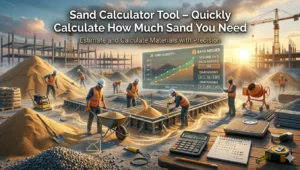
What Is a Sand Calculator and How Does It Work?
A sand calculator is a practical digital tool used to estimate the amount of sand required for construction, landscaping, or home improvement projects. Whether you’re pouring concrete, installing pavers, or preparing a garden bed, knowing exactly how much sand you need can save time, reduce costs, and prevent material waste. In today’s fast-paced construction environment, accuracy matters more than ever, and a sand calculator simplifies what used to be a manual and error-prone process.
At its core, a sand calculator works by using volume-based calculations. By entering key dimensions such as length, width, and depth, along with the density of sand, the tool quickly determines the total volume and weight of sand required. This removes guesswork and helps both professionals and DIY enthusiasts make informed decisions.
Definisi Sand Calculator
A sand calculator is essentially a volume estimation tool designed specifically for granular materials like sand. It calculates the quantity of sand needed based on the dimensions of a given space. These tools are often available online as free calculators or integrated into construction software.
Unlike general-purpose calculators, a sand calculator accounts for factors like compaction, density variations, and unit conversions. This makes it far more reliable for real-world applications, especially when precision is critical.
Cara Kerja Kalkulator Berbasis Volume
The working principle behind a sand calculator is straightforward: it calculates volume first, then converts that volume into weight if needed. The formula used is:
Volume = Length × Width × Depth
Once the volume is calculated (usually in cubic meters or cubic feet), the calculator multiplies it by the density of sand to determine the weight. This is particularly useful when purchasing sand, as suppliers often sell by weight rather than volume.
Parameter Utama yang Digunakan:
Length
The length of the area where sand will be applied. This is typically measured in meters or feet and represents one side of the surface.
Width
The width is the perpendicular measurement to the length. Together, length and width define the total surface area.
Depth
Depth refers to how thick the layer of sand will be. This is a crucial parameter, as even small changes in depth can significantly affect the total volume.
Density of Sand
Sand density varies depending on moisture content and grain size, but a common average is around 1,600 kg per cubic meter. Accurate density values improve calculation precision.
Why Builders Use a Sand Volume Calculator Today
In modern construction, efficiency and accuracy are essential. Builders rely on sand volume calculators to streamline planning and avoid costly mistakes.
Menghindari Kekurangan atau Kelebihan Material
Running out of sand in the middle of a project can cause delays, while ordering too much leads to unnecessary expenses and storage issues. A sand calculator helps strike the right balance.
Membantu Estimasi Biaya Proyek
Material costs form a large portion of any construction budget. By knowing exactly how much sand is needed, project managers can estimate costs more accurately and avoid budget overruns.
Digunakan oleh Kontraktor, DIY Builder, Landscaper
From professional contractors to homeowners working on DIY projects, sand calculators are widely used across different skill levels. Landscapers, in particular, benefit from precise calculations when designing outdoor spaces.
The Importance of Accurate Sand Estimation in Construction
Accurate sand estimation is not just about convenience—it directly impacts the success of a project.
Dampak Kesalahan Estimasi
Underestimating sand requirements can halt construction, while overestimating leads to wasted resources. Both scenarios negatively affect project efficiency.
Efek terhadap Waktu Proyek
Delays caused by material shortages can disrupt schedules and increase labor costs. Accurate calculations help keep projects on track.
Pengaruh pada Budget Material
Even small miscalculations can accumulate into significant financial losses, especially in large-scale projects. A sand calculator minimizes this risk.
Types of Projects That Require a Sand Calculator
Sand calculators are versatile tools used in a wide range of construction and landscaping projects.
Sand Calculator for Concrete Work
Concrete is one of the most common applications where sand estimation is crucial. Sand acts as a fine aggregate, contributing to the strength and durability of concrete.
Beton Membutuhkan Campuran Pasir yang Tepat
The quality of concrete depends heavily on the correct ratio of materials. Too much or too little sand can weaken the structure.
Estimasi Pasir untuk Slab dan Foundation
When pouring slabs or building foundations, precise sand measurement ensures structural integrity and long-term durability.
Calculating Sand for Concrete Mix Ratio
Concrete is typically mixed in ratios such as 1:2:3 (cement:sand:gravel).
Rasio Umum Beton (1:2:3)
In this ratio, sand makes up two parts of the total mix. Understanding this proportion is key to accurate estimation.
Perhitungan Volume Pasir dalam Campuran
To calculate sand volume:
- Determine total concrete volume
- Divide by total parts (1+2+3 = 6)
- Multiply by the sand portion (2/6)
Example of Concrete Sand Estimation
Suppose you need 1 cubic meter of concrete:
- Sand required = 2/6 × 1 = 0.33 cubic meters
- Convert to weight: 0.33 × 1,600 = 528 kg of sand
Sand Calculator for Pavers and Patio Installation
Sand is commonly used as a base layer for pavers and patios. It provides stability and helps distribute weight evenly.
Kebutuhan Pasir sebagai Base Layer
A well-prepared sand base prevents shifting and cracking over time.
Ketebalan Pasir yang Direkomendasikan
Typical sand depth for pavers ranges from 3 to 5 cm, depending on the project requirements.
Using a Sand Calculator for Landscaping Projects
Landscaping projects often require precise sand calculations for both functional and aesthetic purposes.
Garden Beds
Sand improves soil drainage and structure, especially in clay-heavy soils.
Artificial Grass Base
A compacted sand layer provides a smooth and stable foundation for synthetic turf.
Playground Sand
Safety is a priority in playgrounds, and the correct depth of sand helps cushion falls.
Sand Calculator for Bricklaying Projects
Bricklaying requires sand primarily for mortar, which binds bricks together.
Mortar Calculation
Mortar typically consists of cement and sand in ratios like 1:4 or 1:5.
Estimasi Pasir untuk Pasangan Bata
Accurate sand estimation ensures consistent mortar quality and strong brickwork.
How to Use a Sand Calculator Step by Step
Using a sand calculator is simple, but accuracy depends on proper input.
Step 1 – Measuring the Area Correctly
Mengukur Panjang dan Lebar
Use a measuring tape or laser tool to determine the exact length and width of the area.
Menghindari Kesalahan Pengukuran
Double-check measurements and account for irregular shapes by breaking them into smaller sections.
Step 2 – Determining the Depth of Sand Layer
Ketebalan Standar untuk Berbagai Proyek
- Concrete base: 5–10 cm
- Pavers: 3–5 cm
- Landscaping: varies depending on purpose
Tips Menentukan Kedalaman Ideal
Consider load-bearing requirements, soil condition, and project type when deciding depth.
Step 3 – Entering Values into the Sand Calculator
Cara Memasukkan Data
Input the measured length, width, and depth into the calculator fields.
Unit yang Digunakan (Meter, Feet)
Ensure all units are consistent. Most calculators allow switching between metric and imperial systems.
Step 4 – Understanding the Calculation Result
Hasil dalam Cubic Meter
The primary output is usually volume in cubic meters or cubic feet.
Konversi ke Ton atau Kg
To convert volume to weight:
- Multiply by sand density (e.g., 1,600 kg/m³)
- Convert kg to tons if needed (1 ton = 1,000 kg)
Sand Calculator Formula Explained
Understanding how to calculate sand accurately is essential in construction, landscaping, and DIY home improvement projects. Whether you are preparing a concrete mix, leveling a backyard, or installing a pool base, having the correct sand volume ensures efficiency, cost control, and structural integrity. This guide breaks down the formulas, methods, and practical considerations in a clear and professional yet easy-to-read tone.
Basic Formula for Calculating Volume
The foundation of any sand calculation begins with determining volume. Volume represents the amount of space that sand will occupy, and it is typically measured in cubic units such as cubic meters, cubic feet, or cubic yards.
Volume Formula Used in a Sand Calculator
The most widely used formula is:
Volume = Length × Width × Depth
This formula applies to rectangular or square areas. For example, if you have a space that is 5 meters long, 3 meters wide, and 0.2 meters deep, the volume would be:
5 × 3 × 0.2 = 3 cubic meters
For irregular shapes, the area is often divided into smaller sections, each calculated separately and then summed. This approach improves accuracy, especially in landscaping or custom construction layouts.
Converting Volume to Weight
After calculating volume, the next step is converting it into weight. This is crucial because sand is typically sold by weight rather than volume.
The conversion uses sand density, which varies depending on moisture content and type. On average:
- Dry sand density: ~1,500 kg/m³
- Wet sand density: ~1,700–1,900 kg/m³
Formula:
Weight = Volume × Density
Example:
3 cubic meters × 1,600 kg/m³ = 4,800 kg or 4.8 tons
This step ensures accurate purchasing and prevents material shortages or excess.
Cubic Yard vs Cubic Meter Sand Calculation
Different regions use different measurement systems. Understanding both is important, especially when sourcing materials internationally.
- 1 cubic meter ≈ 1.30795 cubic yards
- 1 cubic yard ≈ 0.7646 cubic meters
Metric system (cubic meters) is commonly used in most countries, while the imperial system (cubic yards) is popular in the United States.
When converting, precision matters. Even small rounding errors can lead to significant discrepancies in large-scale projects.
Converting Cubic Feet to Tons of Sand
In smaller projects, volume is often measured in cubic feet. To convert cubic feet into tons:
1 cubic foot of sand ≈ 45–50 kg (depending on density)
Practical conversion:
- 1 ton of sand ≈ 20–22 cubic feet
Example:
If you need 100 cubic feet of sand:
100 ÷ 21 ≈ 4.76 tons
This quick estimation is especially useful for contractors and DIY enthusiasts who need fast calculations on-site.
Different Types of Sand Used in Construction
The type of sand used significantly impacts both calculation and performance. Density, grain size, and moisture retention all vary across sand types.
Concrete Sand
Concrete sand is coarse and angular, making it ideal for mixing concrete. It provides strength and stability due to its interlocking properties.
Characteristics:
- Rough texture
- High drainage capability
- Strong bonding performance
Common uses:
- Concrete mix
- Pavement base
- Structural foundations
Because of its density, calculations must account for slightly heavier weight compared to finer sand.
Masonry Sand
Masonry sand is finer and smoother. It is commonly used in mortar and finishing applications.
Characteristics:
- Fine grains
- Soft texture
- Easy to spread
Applications:
- Bricklaying mortar
- Plastering
- Decorative finishes
Due to its finer nature, masonry sand compacts differently, which may affect volume estimates slightly.
River Sand
River sand is naturally occurring and sourced from riverbeds. It is one of the most commonly used sands in construction.
Advantages:
- Clean and free from impurities
- Good workability
- Consistent grain size
Disadvantages:
- Environmental concerns due to mining
- Variable moisture content
Its natural composition makes it reliable, but density variations should be considered when calculating weight.
Fill Sand
Fill sand is primarily used for leveling and filling large areas. It is not suitable for structural applications.
Features:
- Coarse and mixed particles
- May contain clay and debris
Uses:
- Land leveling
- Backfilling
- Base preparation
Because of its inconsistency, extra margin (around 10–15%) is often added during calculation.
Utility Sand
Utility sand is a general-purpose material used across various construction tasks.
Applications:
- Pipe bedding
- Traction on roads
- Basic landscaping
It offers flexibility but requires careful estimation due to its varied composition.
Online Sand Calculator Tools and Digital Estimation Methods
Technology has simplified sand calculation significantly. Modern tools reduce human error and save time.
Web-Based Sand Calculators
Web-based tools allow users to input dimensions and instantly receive volume and weight estimates.
Benefits:
- Fast and accurate
- User-friendly interface
- No installation required
Many platforms also include unit conversion features, making them ideal for international projects.
Mobile Apps for Sand Calculation
Mobile applications provide on-the-go calculation capabilities for contractors and DIY users.
Features:
- Offline functionality
- Material cost estimation
- Project tracking
These apps often integrate with other construction tools, improving workflow efficiency.
Spreadsheet Sand Calculation Method
Spreadsheets such as Excel or Google Sheets are powerful tools for customized calculations.
Advantages:
- Fully customizable formulas
- Ability to handle large datasets
- Reusable templates
Example formula in Excel:
=Length * Width * Depth
Users can also integrate density values and automatically convert results into tons or kilograms.
Sand Calculator for DIY Home Projects
Sand calculators are not limited to large construction projects. They are equally valuable for small-scale home improvements.
Calculating Sand for Backyard Projects
Backyard projects often involve irregular shapes and varying depths.
Patio
For patios, a stable sand base is essential. Typically, a depth of 5–10 cm is used.
Steps:
- Measure length and width
- Determine depth
- Apply volume formula
Walkways
Walkways require consistent leveling. Sand is used as a bedding layer under pavers.
Tip: Add 5–10% extra material to account for compaction.
Garden Paths
Garden paths may use decorative sand or mixed materials. Estimation should consider design variations.
Sand Calculator for Pool Base Installation
Installing a pool requires precise sand calculation to ensure a level and stable base.
Typical depth:
- 5–15 cm depending on pool type
Key considerations:
- Even distribution
- Compaction factor
- Moisture content
Using a sand calculator helps avoid uneven surfaces that could damage the pool structure.
Playground Sand Volume Estimation
Playgrounds require safe and sufficient sand coverage to cushion falls.
Recommended depth:
- 20–30 cm
Steps:
- Measure play area dimensions
- Multiply by desired depth
- Convert to weight for purchasing
Safety tip: Always choose clean, washed sand suitable for children.
Common Mistakes When Using a Sand Calculator
Using a sand calculator can make construction planning significantly easier, but it’s not foolproof. Many users—ranging from DIY homeowners to experienced contractors—still make avoidable mistakes that lead to inaccurate estimates, wasted materials, and unexpected costs. Understanding these common pitfalls is essential if you want reliable results and efficient project execution.
Incorrect Area Measurements
One of the most frequent and costly mistakes is starting with inaccurate measurements. A sand calculator is only as reliable as the data you input. If your length, width, or depth values are even slightly off, the final volume calculation will be incorrect.
Why Measurement Errors Happen
Measurement errors often occur due to rushed site assessments or the use of improper tools. For example, relying on rough estimates instead of precise measuring tapes or laser tools can easily introduce discrepancies. Uneven terrain also complicates measurements, especially in landscaping or outdoor construction projects.
Impact on Material Estimation
Even a small miscalculation in area dimensions can lead to significant overestimation or underestimation of sand volume. For instance, a 5% error in measuring a large patio area could result in ordering hundreds of kilograms too much or too little sand.
How to Avoid This Mistake
Always measure the project area carefully and consistently. Use professional tools such as laser distance meters for better accuracy. If the area is irregular, divide it into smaller, manageable shapes (rectangles, triangles) and calculate each section separately before summing the total.
Ignoring Sand Compaction
Sand compaction is another critical factor that many users overlook. When sand is poured and spread, it often settles and compacts over time, reducing its volume.
What Is Sand Compaction?
Compaction refers to the process where sand particles settle closer together, minimizing air gaps. This happens naturally under pressure, moisture, or vibration.
Why It Matters in Calculations
If you calculate sand volume without considering compaction, you may end up with insufficient material. For example, a base layer for paving may initially appear adequate, but after compaction, it could become too thin to provide proper support.
Practical Considerations
Different types of sand compact differently. Coarse sand tends to compact less than fine sand. Moisture levels and application methods (manual vs mechanical compaction) also affect the final volume.
Using the Wrong Sand Density
Sand density is not universal. It varies depending on the type of sand, moisture content, and grain size. Many calculators use a default density value, which may not match your specific material.
Types of Sand and Their Densities
- Dry sand: lighter, typically around 1,400–1,600 kg/m³
- Wet sand: heavier due to water content, around 1,800–2,000 kg/m³
- Compacted sand: even denser depending on pressure applied
Consequences of Incorrect Density
Using an incorrect density value can distort weight calculations. This is especially important when ordering sand by weight rather than volume. You might either exceed your budget or run short during the project.
Best Practice
Always confirm the type of sand you are using with your supplier. Request density specifications and adjust the calculator inputs accordingly.
Forgetting Extra Material for Waste
Another common oversight is failing to account for material waste. In real-world projects, not all sand ends up in its intended place.
Sources of Material Loss
- Spillage during transport or handling
- Uneven distribution
- Wind or environmental factors
- Over-excavation or uneven surfaces
Why a Buffer Is Essential
Without a buffer, even a perfectly calculated estimate may fall short. This can delay your project and increase costs due to additional orders and delivery fees.
Recommended Buffer Range
Most professionals recommend adding 5–10% extra sand to your calculated volume. For complex or large-scale projects, the buffer may need to be even higher.
Tips to Improve Accuracy When Using a Sand Calculator
Achieving precise results with a sand calculator requires more than just entering numbers. Professionals follow specific practices to ensure their calculations align with real-world conditions.
Always Add a 5–10% Material Buffer
Adding a buffer is a simple yet powerful way to prevent shortages. It accounts for uncertainties that cannot be predicted during the planning phase.
When to Increase the Buffer
- Irregular or sloped surfaces
- Projects involving multiple layers
- Areas with high environmental exposure
Cost vs Efficiency
While adding extra material may slightly increase upfront costs, it often saves money in the long run by avoiding delays and additional deliveries.
Measure Twice Before Calculating
Accuracy starts with measurement. Double-checking dimensions reduces the risk of input errors.
Professional Approach
Contractors often measure at least twice using different reference points. This ensures consistency and helps identify discrepancies early.
Tools That Improve Accuracy
- Laser distance meters
- Measuring wheels for large areas
- Digital leveling tools
Use Project-Specific Sand Density
Instead of relying on generic values, tailor your calculations to the exact material being used.
How to Get Accurate Density Data
Ask your supplier for technical specifications. Many suppliers provide detailed data sheets that include density, moisture content, and recommended applications.
Adjusting Calculator Inputs
Modern sand calculators often allow custom density inputs. Take advantage of this feature to refine your results.
Double Check Unit Conversions
Unit conversion errors are surprisingly common, especially when switching between metric and imperial systems.
Common Conversion Mistakes
- Mixing meters and centimeters
- Confusing cubic meters with cubic feet
- Incorrect weight conversions (kg vs tons)
How to Avoid Errors
Stick to one unit system throughout the calculation process. If conversion is necessary, use reliable tools or built-in calculator functions.
Sand Calculator vs Manual Sand Estimation
Choosing between a sand calculator and manual estimation methods depends on your experience, project complexity, and desired level of accuracy.
Advantages of Using a Sand Calculator
Fast Calculations
A sand calculator delivers results instantly. This is especially useful for quick decision-making during project planning.
High Accuracy
When used correctly, calculators minimize human error and provide precise estimates based on mathematical formulas.
Practical and User-Friendly
Most calculators are designed with intuitive interfaces, making them accessible even to beginners.
Limitations of Manual Calculations
Prone to Errors
Manual calculations require multiple steps, increasing the likelihood of mistakes. Even experienced professionals can make errors under time pressure.
Requires Experience
Accurate manual estimation often depends on practical knowledge and past project experience. Beginners may struggle to achieve reliable results.
Time-Consuming
Compared to digital tools, manual methods take significantly longer, especially for complex or large-scale projects.
Practical Examples of Sand Calculator Usage
Understanding theoretical concepts is important, but real-world examples provide clarity and practical insight.
Example 1 – Sand for a Patio Installation
A homeowner plans to install a rectangular patio measuring 5 meters by 4 meters with a sand base depth of 0.1 meters.
Step-by-Step Calculation
- Area = 5 × 4 = 20 m²
- Volume = 20 × 0.1 = 2 m³
Adding Buffer
With a 10% buffer:
- Total sand required = 2.2 m³
Key Takeaways
This example highlights how simple calculations can quickly become more realistic when a buffer is added.
Example 2 – Sand for Concrete Slab
A contractor needs sand for a concrete slab measuring 10 meters by 6 meters with a base layer depth of 0.15 meters.
Calculation Process
- Area = 10 × 6 = 60 m²
- Volume = 60 × 0.15 = 9 m³
Considering Compaction
Assuming a 10% compaction factor:
- Adjusted volume = 9.9 m³
Final Estimate
Including a buffer, the total requirement may reach approximately 10.5–11 m³.
Example 3 – Sand for Landscaping Bed
A landscaping project involves an irregularly shaped garden bed. The area is divided into smaller sections for easier calculation.
Approach
- Calculate each section separately
- Sum the volumes
- Add compaction and waste factors
Practical Insight
This method demonstrates how flexibility and attention to detail improve overall accuracy.
Frequently Asked Questions About Sand Calculator
Sand calculators have become essential tools in construction, landscaping, and home improvement projects. Whether you’re planning a small backyard upgrade or managing a large-scale building project, understanding how these tools work—and their limitations—can save both time and money. Below, we explore some of the most common questions about sand calculators, explained in a clear, practical, and professional tone.
How accurate is a sand calculator?
The accuracy of a sand calculator largely depends on the quality of the input data and the assumptions used in its formula. In general, most modern sand calculators provide a high level of accuracy for standard applications, often within a margin of error of 5–10%.
Factors That Affect Accuracy
Measurement Precision
The calculator is only as accurate as the measurements you input. Small errors in length, width, or depth can significantly affect the final volume calculation, especially in larger projects.
Shape Complexity
Most calculators assume simple geometric shapes such as rectangles, squares, or circles. If your project area has irregular shapes, curves, or varying depths, the estimate may be less precise unless you break the area into smaller sections.
Compaction and Settlement
Sand can compact over time, especially when used as a base for paving or construction. A sand calculator typically does not account for compaction unless specified, which means you may need to add an extra 5–15% to your estimate.
Moisture Content
Wet sand is denser than dry sand. If your project involves damp conditions, the actual volume required may differ slightly from the calculated value.
Practical Tip
For best results, always round up your calculated volume and add a buffer. This ensures you won’t run short during your project.
Can a sand calculator estimate cost?
Yes, many advanced sand calculators can estimate cost, but this feature depends on whether pricing data is included or manually entered.
How Cost Estimation Works
Price Per Unit Input
Most calculators allow you to input the price per cubic meter, cubic yard, or ton of sand. Once the volume is calculated, the tool multiplies it by the unit price to give a cost estimate.
Delivery Fees
Some calculators include optional fields for delivery costs, which can significantly impact the total expense—especially for bulk orders.
Material Type Variations
Different types of sand (e.g., river sand, mason sand, concrete sand) have different prices. A reliable calculator may allow you to select the type of sand to refine the estimate.
Limitations of Cost Estimates
Regional Price Differences
Sand prices vary depending on location, supplier, and availability. A calculator cannot always reflect real-time market fluctuations unless it is connected to a live pricing database.
Additional Costs
Costs such as labor, equipment rental, and waste disposal are typically not included in basic sand calculators.
Practical Tip
Use the calculator as a baseline estimate, then confirm pricing with local suppliers for a more accurate budget.
What unit is best for sand calculation?
The best unit for sand calculation depends on your project type, regional standards, and personal preference. The most commonly used units include cubic meters, cubic yards, and tons.
Common Units Explained
Cubic Meters (m³)
Widely used in most countries, especially in Europe and Asia. Ideal for construction projects and bulk material estimation.
Cubic Yards (yd³)
Common in the United States and some parts of Canada. Frequently used in landscaping and residential construction.
Tons (Weight-Based)
Used when sand is sold by weight rather than volume. This unit requires knowledge of sand density to convert from volume.
Choosing the Right Unit
For Construction Projects
Cubic meters are generally preferred because they align with engineering standards and building codes.
For Landscaping
Cubic yards are often easier to visualize and work with, especially for smaller projects like garden beds or patios.
For Purchasing
If your supplier sells sand by weight, using tons may be more practical.
Conversion Considerations
Volume to Weight Conversion
To convert cubic meters to tons, you need the density of the sand. For example:
- 1 cubic meter of sand ≈ 1.4 to 1.6 tons (depending on moisture and type)
Avoiding Conversion Errors
Always double-check conversion factors and use consistent units throughout your calculation to prevent costly mistakes.
How much sand is in one cubic meter?
One cubic meter represents a volume of sand measuring 1 meter in length, width, and height. However, the actual weight of sand in that volume can vary depending on several factors.
Typical Weight Range
Dry Sand
- Approximately 1,400 to 1,600 kilograms per cubic meter
Wet Sand
- Can weigh between 1,600 to 1,800 kilograms per cubic meter due to added moisture
Compacted Sand
- May exceed 1,800 kilograms per cubic meter depending on compression level
Why Weight Matters
Transportation Planning
Knowing the weight helps determine how many truckloads are needed and ensures compliance with load limits.
Structural Considerations
In construction, weight impacts load-bearing calculations and foundation design.
Practical Example
If your project requires 2 cubic meters of dry sand:
- Estimated weight = 2 × 1,500 kg = 3,000 kg (or 3 tons)
This example shows why understanding both volume and weight is crucial for accurate planning.
Is sand density always the same?
No, sand density is not constant. It varies based on several environmental and material factors, making it an important consideration when using a sand calculator.
Factors Influencing Sand Density
Grain Size and Shape
Fine sand packs more tightly than coarse sand, resulting in higher density. Angular grains also compact differently compared to rounded grains.
Moisture Content
Water fills the spaces between sand particles, increasing overall density. This is why wet sand is heavier than dry sand.
Compaction Level
Loose sand has more air gaps, while compacted sand is denser and heavier.
Type of Sand
Different types of sand—such as silica sand, river sand, and manufactured sand—have varying densities due to their composition.
Typical Density Ranges
- Loose dry sand: 1,400 kg/m³
- Compacted dry sand: 1,600 kg/m³
- Wet sand: 1,600–1,800 kg/m³
Why Density Variation Matters
Accurate Material Estimation
Using the wrong density value can lead to underestimating or overestimating the required quantity.
Cost Implications
Incorrect estimates may result in purchasing too much or too little material, affecting your budget.
Engineering Precision
For structural projects, even small density differences can impact stability and safety.
Practical Tip
When in doubt, consult your supplier for the specific density of the sand you plan to use. This ensures your calculations are as accurate as possible.
Final Thoughts
A sand calculator is a powerful and practical tool, but it works best when combined with a clear understanding of real-world variables like density, moisture, and compaction. By asking the right questions and interpreting the results carefully, you can avoid common mistakes and ensure your project runs smoothly.
Whether you’re estimating volume, calculating cost, or choosing the right unit of measurement, taking a thoughtful and informed approach will always lead to better outcomes.